
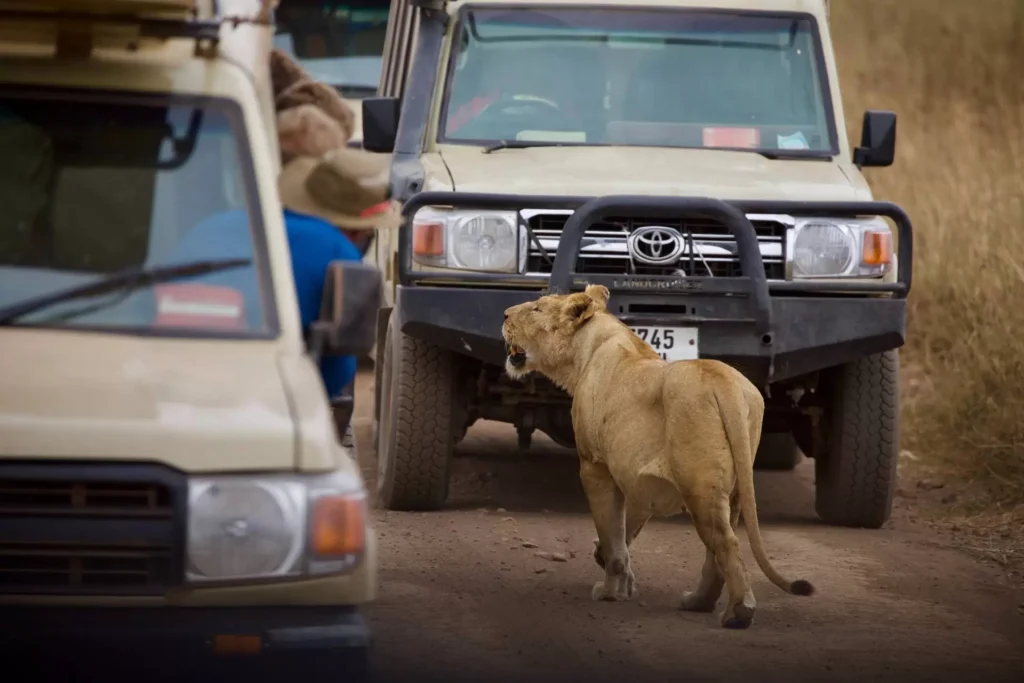
If you’ve ever dreamt of a Tanzanian safari, the image of lions lounging under acacia trees is probably at the top of your mind. But there’s often a lingering question in the back of travelers’ heads:
“If lions are wild predators, why don’t they attack people in safari vehicles?”
The answer is a fascinating mix of biology, behavior, and safari safety practices. In this guide, we’ll explain why lions rarely pose a threat to tourists, how you can safely observe them, and what makes a safari jeep a secure way to experience these incredible animals in the wild.
Lions are one of Africa’s most iconic predators. They are powerful, territorial, and social animals, living in prides that work together to hunt and raise their young.
Key points about lion behavior that keep tourists safe:
| Behavior | Details |
|---|---|
| Territorial | Lions patrol and defend their territory, mainly focusing on prey animals. Humans in safari vehicles are not considered prey. |
| Social hunting | Lions hunt cooperatively, targeting herbivores like wildebeests, zebras, and buffalo — animals similar in size to themselves. |
| Cautious predators | Lions are curious but cautious; unfamiliar objects (like safari jeeps) are often ignored. |
| Energy conservation | Hunting consumes enormous energy. Lions rarely expend it on non-prey objects. |
In essence, lions are efficient predators, and humans in vehicles do not trigger their hunting instincts.
Safari vehicles are treated by lions as non-threatening or unusual objects, not as food sources. Here’s why:
Size and Shape
Lions rarely attack large, upright objects that don’t resemble natural prey.
A jeep, even with multiple passengers, is too big and solid to be perceived as something they can hunt.
Lack of Hunting Signals
Prey animals give subtle signals: trembling, fleeing, or isolated movement.
Humans in vehicles remain calm and do not mimic these signals.
Familiarity Through Repetition
Many safari areas in Tanzania see hundreds of vehicles per day.
Lions habituate to these vehicles over time, learning they pose no threat and provide no reward.
Lack of Food Incentive
A lion is unlikely to expend energy on an object that cannot be eaten.
Safari guides emphasize no feeding of wildlife, reinforcing the behavior over generations.
A typical safari jeep is not only a vehicle but a mobile observation platform designed for safety.
| Feature | Purpose |
|---|---|
| Open-top but elevated seats | Allows good visibility while keeping distance from wildlife |
| Driver and guide expertise | Guides know how to position the vehicle to avoid provoking lions |
| No sudden movement rule | Guides instruct passengers to stay seated and quiet |
| Protective structure | Even open-sided jeeps are large, heavy, and intimidating to predators |
| Group advantage | Lions perceive a full jeep with multiple passengers as a “group” — unlikely to attack |
Pro Tip: Never attempt to leave the jeep or provoke lions — the vehicle itself is safe, but human behavior matters.
Over decades of safaris, lions have learned to ignore humans in vehicles. This process is called habituation:
Lions are exposed to humans and vehicles daily.
They recognize the jeep as a neutral presence, neither food nor threat.
In contrast, lions in remote areas with no safari exposure are naturally more cautious or even aggressive toward unfamiliar stimuli.
Habituation is a natural adaptation — one of the reasons lions in the Serengeti, Ngorongoro Crater, and Tarangire are relatively safe for tourists.
Even though lions generally do not attack vehicles, human behavior plays a crucial role in maintaining safety.
Stay inside the vehicle
Getting out breaks the “neutral object” perception and may trigger curiosity or defensive behavior.
Avoid loud noises
Lions are alert to sounds; shouting or honking can provoke a reaction.
Keep windows and doors closed when instructed
Guides will advise on situations when partial closing is safer, especially with cubs nearby.
Follow your guide’s instructions
Guides have years of experience reading lion behavior and ensuring tourists stay safe.
Many safari travelers report awe-inspiring interactions with lions from the safety of their jeeps:
Close encounters: Lions walking past the vehicle within meters without any aggression.
Cub interactions: Watching lion cubs play while adults lounge near the jeep.
Hunting observations: Witnessing lion hunts in the open plains safely from a jeep.
Pro Tip: Early morning and late afternoon drives are ideal — lions are more active and visible, but still treat vehicles as neutral.
You might worry that lion cubs, being smaller, could be more curious or “playful.” While cubs do explore, adults always supervise, and the jeep’s size prevents close approach.
Cubs may glance, sniff, or investigate from a distance.
Guides position the jeep so passengers can observe cubs safely without disturbing them.
This makes lion cub sightings some of the most memorable experiences for safari travelers.
| Scenario | Likely Lion Response |
|---|---|
| Human walking on a trail in the Serengeti | Avoids or may display defensive behavior |
| Safari jeep on game drive | Ignored, habituated, neutral |
| Group of tourists shouting outside jeep | Alert and cautious, may move away |
| Feeding lions (illegal) | Aggressive, unpredictable, dangerous |
Takeaway: Lions respect vehicles as long as humans respect the rules.
Remain seated and calm — sudden movements can startle lions.
Do not feed wildlife — this breaks natural behavior and safety.
Trust your guide — they know lion moods, positions, and safe distances.
Avoid getting too close — binoculars or cameras with zoom lenses are perfect.
Respect their space — even though lions ignore vehicles, don’t encroach.
Following these rules guarantees a safe, awe-inspiring safari experience.
Capturing lions in action is a highlight of any safari:
| Tip | Why It Works |
|---|---|
| Use a telephoto lens (200–400mm) | Get close-up shots safely |
| Shoot during golden hours | Early morning or late afternoon for perfect light |
| Focus on behavior, not just portraits | Hunting, resting, playing, or cub interactions tell a story |
| Bring extra batteries and memory cards | You’ll take hundreds of photos in a single drive |
| Shoot from inside the vehicle | Safe and unobstructed views |
Reputable safari operators emphasize safety:
Vehicles are well-maintained and designed for observation.
Guides receive extensive wildlife safety training.
Strict policies prevent tourists from engaging in risky behavior.
Education about lion behavior helps visitors understand what they see and why lions do not attack.
Myth: Lions will attack if you stare at them.
Reality: Lions are curious but cautious; they do not perceive a jeep full of humans as prey.
Myth: Open jeeps are dangerous.
Reality: The vehicle’s size, structure, and group presence make it a neutral object in lion eyes.
Myth: Cubs increase danger.
Reality: Adult lions supervise and protect cubs, making them safer from human approach than isolated individuals in the wild.
Lions are majestic, powerful, and fascinating. But thanks to evolutionary behavior, habituation, and responsible safari practices, they generally ignore safari vehicles and tourists.
A jeep acts as a barrier, vantage point, and safety platform, allowing you to experience the thrill of lions in their natural environment without danger.
By respecting wildlife, following guide instructions, and staying calm, you can witness lions hunting, resting, playing, and interacting — all from a safe, immersive perspective.
See the king of the jungle in action. Learn its behavior. Experience the thrill safely.
We help travelers design safe and unforgettable lion safaris in Tanzania, including:
Serengeti and Ngorongoro lion-focused itineraries
Knowledgeable, experienced guides
Jeep and vehicle arrangements for maximum safety
Opportunities to photograph lions safely up-close
Contact us today to plan your ultimate lion safari and understand why the king of the jungle peacefully coexists with humans on safari jeeps.
WhatsApp us